
How Arrest Warrants Work in Palo Alto County
Iowa Code section 804.1 sets the basic route. A complaint or affidavit must state sworn facts showing probable cause that an offense occurred and that the named person committed it. A magistrate can then issue the arrest warrant. Where the law allows, a citation may issue instead. Palo Alto County sits inside Iowa's unified district-court system. Judicial magistrates issue warrants within their authority, while district associate judges and district judges hold broader criminal jurisdiction. The Clerk of the Iowa District Court keeps the public case record. Palo Alto County Sheriff answers questions about warrant status, service, jail intake, and detainers.
Palo Alto Arrest Warrant Probable Cause
No warrant in Palo Alto County starts with the weekly public list. It starts with sworn facts. A judicial officer weighs those facts against the probable-cause standard, then decides whether process should issue. The complaint, the affidavit, or part of the file may stay restricted. Timing, an active investigation, confidentiality law, or a sealing order can each close that door.
Three terms carry the weight here. A complaint or affidavit is a sworn account of facts offered to support criminal process. Probable cause is the legal basis to believe an offense occurred and that the named person committed it. A citation is an order to appear that Iowa law may permit instead of a warrant.
Iowa's electronic search-warrant rules cover searches of places, persons, and things. They do not create a public arrest-warrant portal. In a rural county like Palo Alto County, electronic judicial review can speed an officer's work without opening protected documents to general browsing.
Arrest Warrants: What They Contain
Iowa Code section 804.2 requires core identifying and judicial details on the face of a warrant. The public Sheriff's PDF shows some related fields, not the full warrant document. Treat a roster row as a lead only. It lacks a visible warrant number, case ID, return status, and service history, so the Clerk or Sheriff in Palo Alto County must fill those gaps.
Palo Alto Arrest Warrant Check Routes
Start with the official Palo Alto County Sheriff Warrants page. It links a downloadable weekly list and warns that updates can lag. There is no public name-search form there. Read the PDF with care, since absence from it does not prove that no warrant exists.
- Use the Sheriff's current weekly file as a preliminary public lead.
- Search Iowa Courts Online by name, Palo Alto County, and likely criminal case type.
- Call the Clerk at 712-852-3603 about the public case and docket.
- Call the Sheriff at 712-852-3535 for active status, service, and surrender guidance.
- Use a focused public-record request when the needed existing record is not online.
The official Palo Alto County court page puts the Clerk at 1010 Broadway, Emmetsburg, Iowa 50536, open weekdays from 8:00 a.m. to 4:30 p.m. Public case access may be available on court terminals. The Clerk cannot give legal advice or change a warrant.
How Warrants Get Served in Palo Alto County
Chapter 804 lets a peace officer execute an Iowa arrest warrant anywhere in the state. The Palo Alto County Sheriff's law-enforcement branch serves court documents and retrieves prisoners held elsewhere on county warrants. Its jail processes local arrests and coordinates out-of-county, out-of-state, and federal detainers. A detainer can affect custody, but it is not always the same instrument as a local arrest warrant. The Sheriff's official site notes that a deputy, a communications operator, and a jailer are on duty around the clock. That coverage does not keep the Clerk's public-record counter open at all hours. Call 911 for an immediate threat. For routine confirmation, use the published non-emergency Sheriff number. Never approach or try to apprehend someone you believe is wanted. Deputies handle that work in Palo Alto County.
Palo Alto Arrest Warrant System Layers
The weekly PDF is only the visible layer. Sheriff's communications enters arrest-warrant information into NCIC. Iowa also runs the Iowa On-line Warrants and Articles System, called the IOWA System, for criminal-justice agencies. Neither network allows a public self-search, and no commercial lookup in Palo Alto County or elsewhere should be described as access to either.
| Source | Public use | Main limit |
|---|---|---|
| Sheriff weekly PDF | Preliminary local list review | Weekly timing and possible delay |
| Iowa Courts Online | Case and docket research | Not an official active-warrant database |
| Clerk or records request | Existing public court records | Confidential items may be withheld |
| NCIC and IOWA System | Agency operations | No public access |
Iowa Code section 22.7 and record-specific rules also limit public access in Palo Alto County. Juvenile records, protected data, active investigative material, and some unexecuted warrant records may be withheld or redacted.
Arrest Warrants, Summonses, and Bench Warrants
Each of these forms demands action, but they start differently. A new arrest warrant follows a probable-cause finding. A citation or summons directs a person to appear without authorizing custodial arrest the same way. Bench warrant is common shorthand for process tied to a missed duty in an existing case. Iowa section 805.5 calls for an arrest warrant after a willful failure to appear.
| Process | Core purpose | Useful first record |
|---|---|---|
| Arrest warrant | Authorizes custody after probable cause | Complaint, warrant, and criminal docket |
| Citation or summons | Commands an appearance | Citation and scheduled court event |
| Bench or FTA warrant | Responds to a missed court duty | Existing case docket and FTA order |
Labels in a public notice may be shortened. In Palo Alto County, read the actual order and case history to see what issued.
Palo Alto Arrest Warrant Bond Questions
A Palo Alto County warrant may be bailable. Iowa Code section 804.3 lets a judicial officer set a bail amount or attach conditions to release. When court is out of session, the statewide uniform bond schedule supplies class-based reference figures instead. Those numbers are only a start. Judicial discretion, the actual offense, listed exceptions, and any prior order still control the outcome. Forcible felonies and several named serious offenses get no scheduled bond at all until a judicial officer acts. The official statewide bond schedule shows why a listed amount needs that context.
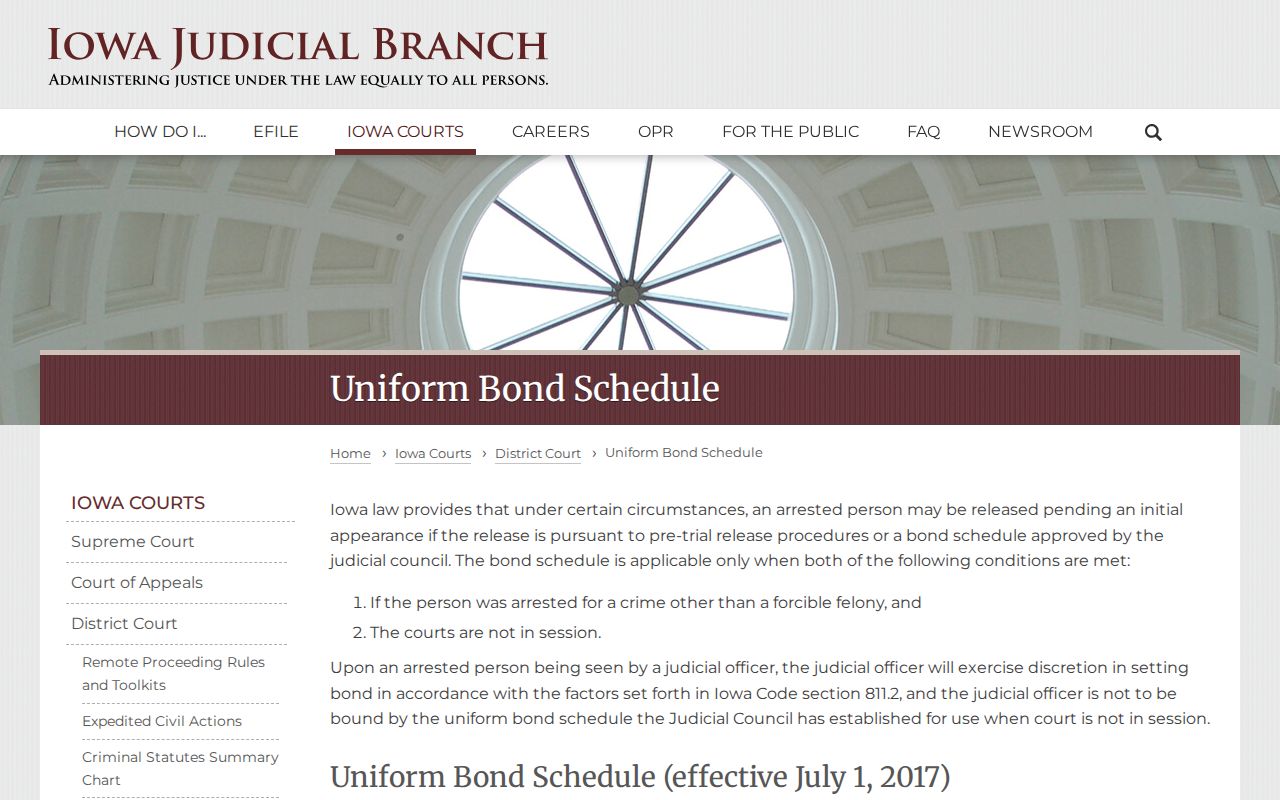
That schedule is no promise of the bond in a live Palo Alto County case. Listed amounts go stale. The Sheriff's roster has a Bond field, yet it shows no complete posting workflow. Confirm the amount. Then confirm any conditions, the payment method, and whether a judge must act first. Fines, court debt, collection fees, and jail program charges are not bond.
Handling an Arrest Warrant in Your Name
Do not let the PDF alone decide when or where you appear. Palo Alto County has no automatic warrant-recall service, special clearance desk, or after-hours bond window. The safe route depends on the charge, the issuing court, the current bond order, your location, and any other detainer.
- Use official sources to identify the case and issuing court.
- Contact an attorney for advice about surrender, bond, and court filings.
- Call the Clerk for the public docket and applicable court procedure.
- Call the Sheriff for current status and official surrender or service instructions.
- Confirm every payment or bond demand through a published official number.
Act carefully: A public-list entry may be delayed, so verify current status before taking any surrender or payment step.
Is the person outside Iowa? Then ask the Palo Alto County Sheriff about transport, service, and any detainer. A local payment will not release another agency's hold.
Safe Palo Alto Warrant Verification
Scammers target warrant fears. A June 2026 Iowa Judicial Branch alert warned of callers posing as court or law-enforcement staff. The threats feel urgent. Demands may involve prepaid cards, cryptocurrency, a Social Security number, or payment through a link or number inside the message. Real agency names change nothing. Open Iowa Courts Online yourself. Reach the Palo Alto County Clerk or Sheriff through a published number, never one the caller supplies. Name a specific record in your request. Ask for a public complaint, a warrant entry, a bond order, a docket entry, or a return. Staff cannot reach legal conclusions for you. Under the Iowa Open Records Law and court rules, a custodian may redact or withhold protected content and may charge actual copy, postage, or staff costs.
Remember: A warrant allegation is not guilt, and a public omission is not proof that no warrant exists.